 Mahjong Racer Games

Sand Water Physics Sandbox succeeds as a digital stress-relief tool because it removes every typical game pressure: no scores, no timers, no fail states. The Pixel Engine delivers consistent, believable particle interactions that reward curiosity rather than skill. Its simplicity makes it accessible to all ages, though players seeking goals or progression will find none. The experience is best approached as a toy—something to fiddle with for a few minutes or lose track of time while experimenting. The lack of objectives is both its strength and its limitation, depending on what you want from a game.
The core of Sand Water Physics Sandbox is its Pixel Engine, which governs how individual sand and water particles move and interact. Sand falls, accumulates into mounds, and shifts when disturbed. Water spreads, pools in low areas, and flows around obstacles. Because the engine simulates each particle, every action produces a believable reaction—pushing sand into a stream changes its course, and digging a channel redirects water. This granularity is what separates the experience from static drawing tools.
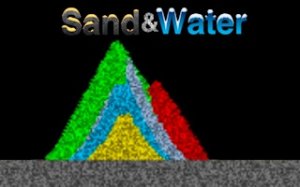
Interaction is handled entirely through mouse or touch controls. Players can collect particles, place them elsewhere, or build barriers to influence flow. There is no avatar to move and no menu of complex tools; the interface stays out of the way. A typical session involves dropping sand to form hills, then releasing water to see how it carves through the pile. [IMG_1] The lack of penalties means mistakes are simply new starting points for further experimentation.
Sand Water Physics Sandbox deliberately omits scores, time limits, and win conditions. The game does not track progress or reward specific outcomes. Instead, it invites players to set their own small goals—such as creating a dam that holds, or watching how far a water stream travels before soaking into sand. This structure makes it suitable for short breaks or longer, unhurried sessions. The absence of failure states keeps the tone consistently calm.
Because there are no rules or pressure, the game appeals to anyone seeking a low-stakes digital toy. It is safe for all ages and works as a stress-relief tool. New players may find that the most rewarding approach is to start with a simple action—letting sand fall into a pile—and then introduce water to observe the result. Building barriers to redirect flow is a natural next step. Patience and curiosity matter more than reflexes or strategy.
Sign in to comment
You must be logged in before posting a review or rating.
No comments yet. Be the first to comment!









Editorial Notes